
Keeping on the Move...
When aggressors try to obstruct your path


In many street scenarios, where a potential aggressor tries to harass or assault someone, they will use various tactics to get the intended victim to stop moving, or feel trapped.
These stop tactics range from the psychological and deceptive right through to blatant physical attacks or obstructive manoeuvring…
There’s an increasing number of assaults, particularly against women and young people, taking place across Europe. Through my work in the self-protection field, I continue to meet more people deeply concerned about this.

These are incidents that can take place in the middle of the day or on public transport, or within nocturnal social settings.
The imagery of grim attackers simply lurking in dark alley ways and urban no go zones- something so often portrayed in 80s action films action films, is less valid today.

Threats emerge in the seemingly mundane environment or bustling social gathering points. Rest assured dear reader, this is not intended to be fear mongering; it's about fear countering. We are aware of the threats; so we take measures to evade them.

Understand the Threats
When people acknowledge there are these threats out there, they may understandably feel concerned for their own safety or that of loved ones. However, they’re not in denial; they are not oblivious.
They are likely to be more alert when they walk about cities or even in the countryside. They will also take measures to ensure their family are safe and more vigilant.

Awareness of the danger can then lead to the next phase- understanding the threat. This includes the mindset, the attitudes and behavioural patterns of the various types of aggressor.
Understand the tactics and ways these individuals close in and get a person to stop.

Stop Tactics
In Tri-Tier, we will make use of various drill, carried out in a calm, relaxed manner to help people develop familiarity of the stop tactics that get used.
Then, we can look at how to help people avoid falling for them or what to do in different situations, if they've been encroached upon.
Today, we are just going to touch on some of these methods. In training, more can be shown.

Deceptive Verbal Stoppers
Here, the aggressor may use friendly dialogue, such as showing interest, asking questions or even using flattery to get the person to stop.
Particularly when it comes to targeting women, they may even believe their verbal interaction will be well received.

Now, they may use more deceptive verbal stoppers- those statements that may seem like they’re in need of help or trying to be helpful to the person they’re talking too.
Young people may inevitably be more susceptible to exciting invitations or false promises. This is something I stress in the young people's travel safety training.

Aggressive Verbal Stoppers
These may involve some kind of initial question or remark but this can soon escalate into pressurising demands or bullish requests. It can also involve abrupt commands. These can cause fear and even a feeling of needing to comply for some people.
Path Obstruction Tactics
This may not necessarily involve a physical grab. At least, not initially. It may simply involve the aggressor blocking one's path by standing in the way or using body language to occupy space and crowd the person.

In Tri-Tier, when we talk about space invaders this is the type of aggressor we’re looking at here; rather than little green men. (Actually, we do talk about those on occasion also!)

Not everyone who uses path blocking tactics represents a violent aggressor, planning to get physical. Sometimes, the space invader can be someone trying to sell something, or enthusiastically draw tourists into a venue.
That's why we have passive ways of negotiating a space invader, as well as more assertive means.

Note, there are also deceptive ploys that are used to get a person to stop. In various countries, street hustlers, pick pockets or muggers may use more unusual tactics, such as dropping an object on the floor.
It could be a wad of cash or a ring, that’s used to coax a courteous person to stop and pick up the object. This then leads to an interaction.

There can also be elaborate role plays and bait like tactics. A couple could pretend to be arguing or a seemingly innocent looking person can act like they need help; only to switch to a more manipulative state.
The selling of an item may be a distraction, used as part of a ploy to swipe your phone or handbag from your table, if you're sat outside a cafe, for example.

This also raises another point. Not all aggressors try to get a person to stop. Sometimes, they will look for someone who is sat down- be it within a cafe or on public transport, or in some kind of confined space.

This means we will also consider ways of how to gain mobility and move away from the threat- from static positions. Our movement may need to be subtle or more assertive.

Psychological and Energetic Disruption
One aspect of self-protection many training approaches tend to fly over is how to handle the energetic state of the aggressor. There are individuals who can be incredibly unbalanced.
Mental health issues may be just one aspect of this. These parties may also be under the influence of narcotics or other substances. They may have deep ingrained hatred or rage. There are other reasons… without trying to sound too esoteric.

The point is- consciously or less consciously, individuals can display behaviour that’s shocking, unpredictable and disruptive to one's nervous system. This barrage to the senses can prevent a person from acting decisively.

For this reason, Tri-Tier focuses, not simply on forging resilience, but how to maintain one's centre, when there are chaotic external factors at play.
This has value in other areas of one's life, as my clients working in The City and in security have been quick to recognise.

Physical Stop Tactics
Some of these stop tactics and subsequent crimes could be carried out by more than one individual, with premeditated plans.
Pack mentality and the type of formations used is therefore another aspect to address. They may use numbers to block the path of the person. One may try to circle behind, or they will approach from each side of the person.

This is why we study how to control one's space and use elusive footwork to flow around threats.
Inappropriate Contact
Before we look at direct physical grabs, it's also worth noting that some of the incidents taking place, especially the one's involving women, may involve some kind of over familiar gesture or inappropriate contact. This in itself can be violating, intimidating and infuriating.

A passive aggressive state may be used by the aggressor to invoke confusion. There are ways to deflect certain gestures without escalating things, or if that doesn't work, how to deflect and protect oneself with focus and intensity.
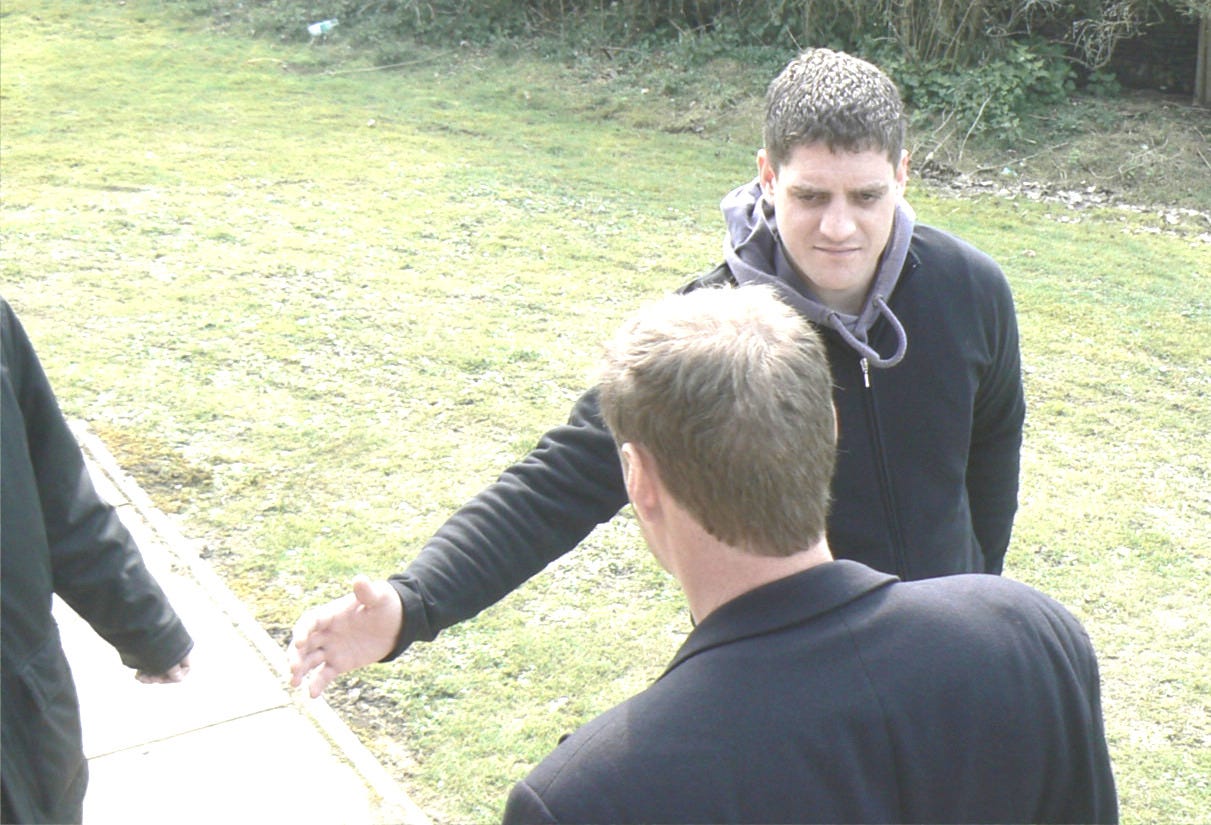
Direct Grabs
In some scenarios, using aggression and sudden force, some aggressors may close in very fast or they’ll try to get close with dialogue. Then, they may use those direct, feral physical grab tactics.

Situational awareness indeed carries merit but a person would do well to understand the physical realm of self-protection and how, with training, one can evade, escape or counter many grab based situations.
Situational awareness is nonetheless crucial in preventing one from being ambushed by a predatory aggressor who tries to sneak up on the person. That’s why it's so important not to be distracted by phones, headphones or one’s thoughts.

In training, we will explore the different types of grabs used and other physical tactics, such as strikes that may be used to stop the person and suppress their ability to fight back.
Equipping People for Current Challenges
There are many areas we will address including: movement skills, the ability to adapt to the unexpected, as well as breathing skills to better manage the immediate pressure and intensity of the situation.

We will also look at ways to enhance awareness, which as conveyed in this feature, requires one to begin by understanding aggressors initiate hostility.
Then, there are ways to help people read their environment and access an energetic state that conveys that this person is not a vulnerable victim or an inviting target.
Really though, to equip a person is to help them realise what they already have access to...
Aran
About the author
Based in London, Aran Dharmeratnam is the founder of Tri-Tier. He specialises in risk reduction and self-protection training, often working with high-profile figures and their families. With experience in various areas of the security sector, Aran also works with global security companies involved in private investigations and risk intelligence. He’s been deployed on the ground, in numerous cases. Aran’s insights have appeared in The Financial Times, The Spectator, LBC, Aviation Security International, and Security Management Today.
For consultations or training contact: office@tri-tier.com